
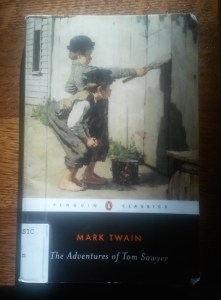
The Adventures of Tom Sawyer

The Adventures of Tom Sawyer by Mark Twain

We decided to head back to a classic tale set in the mid-1800’s The Adventures of Tom Sawyer by Mark Twain after The Trumpet of the Swan.  I don’t ever recall having read this book and I thought my kids would enjoy it and we sure did.

We meet Tom Sawyer playing hookey from school and his Aunt Polly upbraiding him for it.  He is an affable boy of 12 whose life purpose is to have a good time.

Early in the book we see perhaps the most famous scene of Tom Sawyer when Tom is put upon by Aunt Polly to whitewash the fence and he in turn manages to get all of the neighborhood boys to do his work for him by tricking them and telling them it takes a lot of skill to do this.  He discovers the principle of reverse psychology and as the narrator says “he had discovered a great law of human action, without knowing it–namely, that in order to make a man or a boy covet a thing, it is only necessary to make the thing difficult to attain.”  Classic!

We follow Tom in his adventures, including when one night he and Huck Finn sneak out of the house and go to a cemetery and witness a murder.  Tom ends up testifying at the trial and ends up freeing a man wrongly accused.  We see him take a beating at school for the girl he likes, Becky Thatcher.  He decides to “play pirate” and him and three other boys go and live on an island for a few days during which time the townsfolk take them for dead and Tom and his friends show up at their own funerals!  And we see him and Huck on a quest for buried treasure and they find it in a cave that Tom and Becky get lost in!

In the end, both Tom and Huck split the stolen money and with proper prudence from Becky’s dad who is a judge the boys become the richest people in town.

This book is fast-paced with no dull moments.  Full of great moral values for the times.  Huck frees a man wrongly accused by testifying of what he saw that night in the graveyard.  Twain propounds “knowledge is worth more than anything there is in the world” when Tom fusses about memorizing Bible verses.  Tom feels bad about tricks he plays on his aunt.  He discovers “that to promise not to do a thing is the surest way in the world to make a body want to go and do that very thing.”  When the boys are missing and when Tom and Becky are lost in the cave, the families and the whole town pray and search for them.

Short and fun and full of teaching moments and of what life once used to be like in the 1860’s and how life has changed.  For example, Tom and Huck return to the cave to find the treasure.  They take a boat and travel 5 miles down river.  I told the kids that could never happen today.  One, their parents wouldn’t let them.  Two, the cops would be called if they were discovered.  Three, most kids can’t sail a boat at age 12.  But back then it was commonplace.  When the boys are “playing pirate” on the island, they light their own fires, fish for their own food, build a shelter, and basically go camping today but with no modern conveniences.  Great fun and highly recommended!

The Trumpet of the Swan

The Trumpet of the Swan by E.B. White

So after reading Little Women, which was a challenge, I picked an easier book, one I knew my son would enjoy:  The Trumpet of the Swan by E.B. White.  Boy, was I glad I did!

We follow a young trumpeter swan named Louis who was born with a “defect”–no voice.  For trumpeter swans, this is serious indeed as swans court females with their voices.  So since Louis can’t speak he decides to learn to read and write.  Then he could communicate with other swans.  Here, he engages the help of his human friend, Sam Beaver.  Sam Beaver is a young boy of eleven who witnesses Louis’ birth on a small lake while he is camping with his father.  He becomes friends with Louis and his family.  So Louis goes with Sam to school.  When Louis returns, he falls for a young swan named Serena.  However, she ignores him because he cannot speak and she cannot read.

Concerned for Louis’s future and wanting to give him everything his heart desires, Louis’s father, known in the book as the cob which is the word for a male swan, steals a trumpet from a music store in Billings, Montana.  He gives it to Louis so that he may woo Serena.  However, knowing the trumpet has been stolen, Louis sets out to earn money to pay for it.  Once again he seeks out his friend, Sam Beaver.

Louis goes to camp with Sam where he works on playing the trumpet and learns songs to play to earn money.  He then goes to Boston and plays there for swan boats.  Then it’s off to the Philadelphia Zoo where Louis plays at a night club.  By the end of his gig, he has earned over $4600, more than enough to pay for the trumpet and the damage to the store when his father crashed through the window to steal the trumpet.  Louis gives the money to his father who takes the money to the store owner.

Now, Louis is debt free and is able to court Serena who falls in love with his trumpet playing.  Louis settles down to a private life, raising his cygnets (baby swans) and living quite happily.  He still sees Sam at the lake where they go camping and at the Philadelphia Zoo where Sam now works and where Louis visits.  Louis still plays his trumpet for his family.

The books ends with Louis settling in for the night, thinking of how “lucky he was to inhabit such a beautiful earth, how lucky he had been to solve his problems with music, and how pleasant it was to look forward to another night of sleep and another day tomorrow, and the fresh morning, and the light that returns with the day.”

Great story.  So many life lessons.  One, repaying debts owed.  Two, friendship.  Three, the simplicity of life.  Four, family obligations.  Five, keeping promises.  Six, following your dreams (Louis’s is to live in the wild, free–“we must all follow a dream”).  Seven, how defects or handicaps or disadvantages shouldn’t hold you back.  Eight, hard work pays off.

The cob tells Louis “There may even be some slight advantage in not being able to say anything.  It compels you to be a good listener.  The world is full of talkers, but it is rare to find anyone who listens.  And I assure you you can pick up more information when you are listening than when you are talking.”

Another life lesson from Louis:  “He needed money badly, and when you need money, you are willing to put up with difficulties and uncertainties.”  Great lesson often forgotten today, especially among our young people.

We finished this book in four days it was so good.  Fast paced.  Funny, especially the cob who talks and talks and talks and his wife, known as the swan, who always puts him back on the right track.  Feel good.  Great story about finding your voice in this world where voices are more often thrust upon us than discovered.

I could go on and on.  Another one:  Louis achieves great fame and is in demand for his talents and skills; yet, he rejects it all for the life he desires.  He only earns enough for his debts and his needs and no more.  The rest will take care of itself.  Great example for us.

This books is personification at its best–totally believable that a swan could learn to read and write and earn money in such a way.  I recommend this book highly.  Younger kids will love the story.  Older kids will get more of the life lessons.  And us writers will be inspired to write.  And adults who aren’t writers will be left with a flutter in their hearts and a sense that life can be just as sweet.

Little Women

Little Women by Louisa May Alcott

Out of all of the books I have recommended for children thus far on this blog, this book tops the list.

I’d never read this classic by Louisa May Alcott when I was a child and we needed to read a Classic Novel for Homeschool so I chose this one.  And I’m glad I did.

We follow the lives of four girls named Margaret (Meg), Jo, Beth, and Amy as they grow up over the span of about 15 years.  When the novel starts, Meg is the oldest at 16 and Amy the youngest at 10.  Mr. March volunteered to be a chaplain in the Civil War so the girls and their mother, Mrs. March, are tending the house alone.  The girls befriend their next door neighbor, a lonesome boy named Laurie Lawrence, who lives with his rich grandfather as he has been orphaned.  He is 15 when the novel opens.

The overarching story has its dramatic moments like when Mr. March gets sick and Mrs. March must leave the girls alone to tend to him in Washington.  During this time, Beth catches scarlet fever and all fear she will die.  She recovers but never fully.  She is left frail and in the end she loses her life at a young age, which she accepts.  Laurie goes off to college.  Meg gets married and has twins.  Jo spends some time in New York where she meets an elderly gentleman whom she eventually marries.  And Amy ends up marrying Laurie.  Jo inherits her rich aunt’s estate when she dies and turns it into a boys’ school.  All the family stays nearby and it concludes with a big family picnic.

This is all great stuff and great writing.  Ms. Alcott does a fabulous job of moving the story along and keeping us in suspense as to when Laurie will ask Jo to marry him (for Laurie fell for Jo first).  Then we wonder if Jo will ever marry or just remain at home in service to her parents.

But the heart of this novel is the tender moments between the girls, the faith they have for God, and the love that emanates through the characters for others and their family.  They all strive to be good “little women” and grow up to be like “Marmee” (Mrs. March) who is a strong woman with upstanding moral values and worldly advice.  They strive to be more thoughtful and less selfish.  They strive to overcome their faults such as a strong temper in Jo and a covetous nature in Meg.  They fight but they always make up.  Jo sells her hair for money for her mother to go and see Mr. March while he’s in the hospital.  While Beth slips away, they surround her in love.

There is so many good quotes in this book it’s unbelievable.  Great advice.  Great God stuff.  Here’s some of my favorites:

Mrs. March’s advice to Jo about controlling her temper:

“Watch and pray, dear; never get tired of trying; and never think it is impossible to conquer your fault.”

Mrs. March to Meg and Jo on marriage:

“I want my daughters to be beautiful, accomplished, and good; to be admired, loved, and respected, to have a happy youth, to be well and wisely married, and to lead useful, pleasant lives, with as little care and sorrow to try them as God sees fit to send.  To be loved and chosen by a good man is the best and sweetest thing which can happen to a woman.”

Mrs. March to all of her daughters on the value of work:

“Take up your little burdens again; for though they seem heavy sometimes, they are good for us, and lighten as we learn to carry them.  Work is wholesome, and there is plenty for every one; is good for health and spirits, and gives us a sense of power and independence better than money or fashion.”

Mrs. March on marriage:

“Each do our part alone in many things, but at home we work together, always.”

“Meg learned that a woman’s happiest kingdom is home, her highest honor the art of ruling it–not as a queen, but a wise wife and mother.”

“Jo recognized the beauty of her sister’s (Beth’s) life–uneventful, unambitious, yet full of the genuine virtues which ‘smell sweet, and blossom in the dust.”

At almost 500 pages, this took us 2 months to read, but it was so worth the time commitment.  Originally published in 1868, this book is timeless in its simple depiction of how a home life should be and you are sure to glean some nugget of wisdom to apply to your life.

Excellent book. Full of faith and God. Great, feel-good story. Will leave a smile on your face. Guaranteed.