
 The Family Under the Bridge by Natalie Savage Carlson is about an old hobo named Armand who one day discovers a family under his bridge. Three kids, a single mother, and their dog, Armand is taken aback. He can’t stand “starlings” as he calls them. Yet the children quickly endear themselves to Armand.
While the mother is working, Armand takes the children to see Father Christmas since Christmas is only a few days away. They all ask for a house from Father Christmas. The children were taken out of school as well so the authorities would not take them away from their mother if they found out they were homeless. All the children desperately want to go back to school.
However, two women discover the children alone under the bridge and head to the authorities. Armand takes the children and their mother to live with the gypsies. However, the gypsies are soon run off as well when one of the gypsies is sought after by the police for cutting down a rare Christmas tree.
Homeless again, the children desperately want a home. It is here that Armand finally decides to take a real job instead of being a hobo. He happens to find a caretaker job where housing is included. In the end, this make-shift family finally has a home.
Written in 1958, this book won the Newbery Honor Award in 1959. If you keep this in mind and use it to study the times it was written in, then this is a good book. There are some elements in this book that you’d never see in a modern book like the cutting down of a rare tree for Christmas. Also, at one point, Armand uses the children to sing so they can collect money for food. And I don’t agree with the fact Armand is a professional hobo. Also, the mother is racist against the gypsies and looks down upon them the entire book.
However, the underlying story is endearing. The children “stole Armand’s heart” by begging to stay with him. Armand’s character arch is impressive as well, going from a life-long beggar, content to not work and saying so, to
beginning to be ashamed of begging as it takes away a man’s self-respect.” In the end, Armand becomes a “workingman of Paris.”
My kids are old enough that when these parts cropped up, we talked about it, and why those parts of the book are wrong. It’s also interesting and telling of the time period when you read these views from so long ago, which spark a discussion of how our thinking has changed.
Good, short read containing lots of teachable moments. Plus, it shows how people can change no matter how old they are.
 Another gem from the Newbery Honor books, Surviving the Applewhites by Stephanie Tolan is an entertaining, funny novel about a delinquent boy who, having been kicked out of school, is forced to be homeschooled by the Applewhite family, themselves an eclectic bunch of misfits. In fact, there are so many characters that in the beginning it’s hard to keep them all straight!
 Lizzie Bright and the Buckminster Boy by Gary Schmidt is on the surface a typical new kid on the block book. Turner Buckminster has just moved from Boston to the small community of Phippsburg, Maine in 1911. His father has taken a job as the local pastor. Turner immediately gets into trouble and trouble keeps finding him. He accidentally skips a rock into a neighbor’s fence. He’s caught with his pants down by this same neighbor as he tries to wash blood out of his pants so his parents won’t find out. And he visits Malaga Island, a place where African-Americans live, and befriends a girl named Lizzie Bright Griffin.
 A Newbery Honor Winner for 2009, Savvy by Ingrid Law is the tale of a family who have amazing abilities and have to learn to control them.
 The Mostly True Adventures of Homer P. Figg by Rodman Philbrick is a delightful tale of a twelve-year old boy who is determined to find his brother who was illegally sold into the army during the American Civil War. Orphans, Homer and his brother are being raised by their mean uncle, Squinton Leach. Squint sells Harold and Homer sets out to find him.
 The Evolution of Calpurnia Tate by Jaqueline Kelly, a 2010 Newbery Honor Award winner, is the story of an eleven-year old girl at the turn of the twentieth century. She is the only girl in a family of seven kids and is expected to act like one when all she wants to do is play outside with her brothers. Her chores are around the house. She must take piano lessons, knit, and cook. Her expected life is one of a wife and mother.
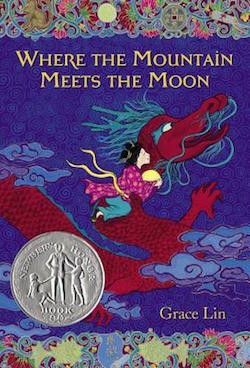 In Where the Mountain Meets the Moon by Grace Lin we meet a girl named Minli who is determined to change her family’s fortune. Both her parents work all day in the fields for just enough food to put on the table. Her father passes the night by story telling while her mother “sighs” over their misery constantly.
