
BSF Study Questions Genesis Lesson 25, Day 2: Genesis 34:1-12

Summary of passage:  Dinah was visiting her friends in town when Shechem, the son of Hamor, saw her and raped her.  He loved her and spoke tenderly to her and asked his father to get her for his wife.

So Shechem’s father came to discuss the situation with Jacob and Jacob and his sons were distressed over what happened.  Hamor asked for Dinah to marry his son along with suggesting they all intermarry and settle amongst them.  Hamor said he’d pay whatever bride price was asked.

Questions:

3)  No.  First, it seems against God’s plan of having him settle in Bethel (Genesis 31:13). He is committing the same sin as Lot–settling near a pagan city with his young kids who are open to influence.

4a)  Yes.  She should have been forbidden to visit the women of the land alone and unprotected.  We must remember this is ancient times where women had no rights and were often treated as animals.   A woman alone could be taken by any man with no consequences.

b)  Lists God’s will of having His people separate from the world and to touch no unclean thing or be yoked to ungodly spouses.  Jacob should have made an effort to stay separate from the pagan Canaanites but he didn’t.

c)  No.  No apology.  Nothing.  But in that culture, Shechem committed no crime.

d)  They seem to treat their women with more respect and they have influence in their lives.  Jacob calls Rachel and Leah to him and asks them BEFORE he flees from Laban and takes away their father’s livestock (Genesis 31).  Abraham drives out Hagar and Ishmael because of Sarah’s wishes, not his own (Genesis 21:10; 16:6).  Rebekah schemed to have Jacob receive the blessing (Genesis 27), which was God’s desires.  God revealed to Rebekah (Genesis 25:23) His will, and not Jacob.

5)  Verses 9-10 is the devil at work.  Hamor is tempting them to intermarry with the Canaanites and adopt their ways and culture and their gods.  Although a ruse for their violent plans, Jacob’s sons suggested they become “one people” (verse 16), something which must have saddened God’s heart greatly.

Conclusions:  This passage, as sad as it is, speaks volumes of ancient culture.  It shows how women were merely objects to be possessed with no rights and how men could slaughter an entire village and get away with it with no repercussions whatsoever. Lawlessness, sinfulness, deceit–all in need of God and an order to life.

Even the whole idea of a bride price where women were bought and sold based on whims (and more likely a desire for power and alliances or what-have-you) which lasted up until modern history (and still happens in some cultures today) is very disheartening and sad.

I know that Abraham, Isaac, and Jacob showed a higher respect for women but it was no where near today’s levels or what it should have been.  Just look at Leah and Rachel–a fight that destroyed the family all based on the pressure to bear sons (which was the primary goal of women).  Very sad.

It’s very hard for us to understand what it must have been like 4000 years ago for Dinah or Rachel or Leah or any woman.

It reminds me to be grateful I do live in today’s society where I am able to type these words for all to read.  Where my daughters can do whatever they dream of (as well as me). Where I have the freedom to marry whom I choose and not have kids if I choose. Where I can walk around without fear of what may happen to me.  Where if I am violated, the perpetrator will be punished lawfully.

Where I am a person, made in God’s image, and just as precious as any man.  And not just in God’s eyes.  But in society’s eyes as well.
BSF Study Questions Genesis Lesson 24, Day 5: Genesis 33

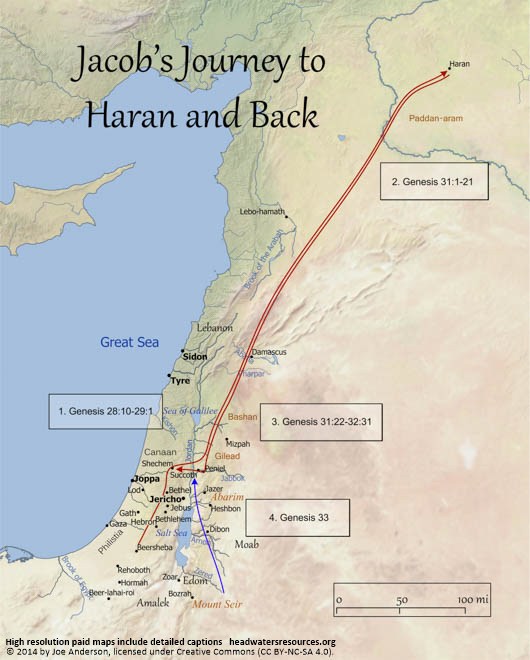
map of succoth and peniel www.atozmomm.comSummary of passage:  Jacob sees Esau coming towards him with 400 men so he divides up the women and children, putting the maidservants first, then Leah and her kids and finally Rachel and Joseph in the rear (obvious preference here).  He went ahead and bowed 7 times to greet his brother.

Esau ran to meet Jacob and welcomed him with open arms.  They wept and kissed.  Jacob introduced his family and then insisted that Esau keep his gift of animals, saying to see his face is like seeing God’s.

Esau offered to accompany Jacob the rest of the way home, which Jacob refused, citing the fact his herds had a lot of babies and needed to go slow.  Esau offered to leave some of his men with Jacob but Jacob refused that as well.

So Esau went back to Seir while Jacob went to Succoth to shelter.  Then he ventured on to Shechem where he bought the land upon which to pitch his tent.  He set up an altar.

Questions:

14a)  He bowed down to the ground 7 times upon meeting Esau.  He calls himself Esau’s servant and his lord.  He insists Esau keep his peace offering of animals.

b)  They both wept.  He compared seeing Esau’s face to seeing God’s face (no light statement).

c)  Esau is genuinely glad to see Jacob.  He runs to him, embraces him, kisses him, and he weeps.  He asks to meet Jacob’s family and he attempts to refuse Jacob’s gift of animals. A selfish man would have gladly accepted.  He offers to accompany Jacob back “home” and to offer an escort of men as well.

15)  No where does it say in this passage Jacob passed 10 years at Shechem.  In fact, it doesn’t say.  This is a guess by scholars based off of a guess at Dinah’s age.  Genesis 31:13 seems to imply that God is calling Jacob to Bethel.  And in Genesis 35:1, God specifically calls Jacob to Bethel.

We all know if God calls, you go and go NOW!  Don’t wait!  Like the servant’s example in bringing back Rebekah, we must do God’s will and promptly.  There is no time to wait. Especially when we know life is so very short.

Conclusions:  In that culture, the act of Esau accepting the gifts was an act of forgiveness.  You never accepted gifts from an enemy.  With Esau’s acceptance, all was put right between the two brothers.

Jacob is still afraid of Esau.  He doesn’t want Esau to accompany him and he ends up lying to him, saying he will follow him when Jacob instead goes the opposite direction. Despite having wrestled with God, Jacob is STILL not trusting God to be in control and lead him.  Jacob inserts “Jacob” instead of “Israel” here and lingers where he should not.

Plus, Genesis 31:13 seems to imply God is calling Jacob to Bethel.  So why does he stop here in Shechem?  Fear.  Obstinance.  Desire to still be in charge.

One commentary I read suggested Jacob wanted to be close to the city (based off of Genesis 33:18), which is speculation in my view.  I believe Jacob just wanted to be away from Esau so he went in the opposite direction and stopped somewhere, which happened to be Shechem.

Interesting, however, to note that Jacob is repeating Lot’s sin of wanting to be close to Sodom.  As we shall see in chapter 34, sinful people have an unduly influence upon the godly.

Map Work:  Map of Shechem and Bethel with Jabbok River HERE

Another one with Succoth and Peniel HERE

BSF Study Questions Genesis Lesson 24, Day 4: Genesis 32:20-32

Summary of passage:  Jacob sends pacifying gifts to Esau ahead of him while he stayed behind.  He sent his family and possessions across the River Jabbok.  He was left alone and he wrestled with a man all night.  The man touched the socket of Jacob’s hip as they wrestled.  Jacob asked for a blessing from the man before he let him go.  The man asked his name and then changed it to Israel because he had struggled with God and men had overcome.

He was blessed by the man and the place was called Peniel.  Jacob was limping from his battle.

Questions:

9)  He hasn’t yet fully trusted in God.  He hasn’t submitted his will to God’s.  He hasn’t surrendered nor died to self.

10)  We are told Jacob struggled with the angel and overcame him.  Jacob then wept and begged for the angel’s favor.  We are told this took place near Bethel.

11)  The man was God in the person of Jesus for we know God himself never appeared to man (Exodus 33:20; John 1:18; John 6:46).  Verse 28 says it clearly when the man speaks and tells Jacob “you have struggled with God”

12)  Ok.  A bit presumptuous, isn’t this question?  No one “forces” God to do anything.  So just knowing that one fact about God you know the answer to this question.

Jacob is accepting God’s blessing.

13)  When we fight His will for our life.

Conclusions:  Like Day 2, I’m left with mixed feelings on this lesson (as you may have been able to tell by their brevity). This is a very famous passage in the Bible.  My Bible heading is “Jacob Wrestles With God” and it seems as though BSF focuses too much effort on getting us to realize this is God (the obvious) instead of focusing on the end results and how Jacob needed God to show up in his life again (as I do right now)–and the not-so-obvious.

I would have preferred more questions like 13 instead of like 11 and 12.  My opinion, of course.  This passage has such depth and meaning as it shows how we all wrestle with God until we finally submit to Him.  Instead, we are left hanging.  A missed opportunity by BSF.

We all need to surrender our will and our self-reliance (hard to do in America) to God.  It is God’s way on His “Way of Holiness(Isaiah 35:8) or the other highway.  God must be our center.  God must be in control.  God must conquer us.  When we are defeated by this world and all that happens to us, we weep to God for His blessings as Jacob did.  We come crawling to Him, broken.  Right where we need to be in order to move forward into the Promised Land.  As Jacob shows us.

“I will not let you go unless you bless me”.  Jacob grasps the Lord with all his strength, knowing how much he needs God.  We must do the same.  All the time.  Hold onto God and never let go.

Jacob’s enemy is not Esau.  It is self.  It is death to self that Jacob is struggling against.

The name change signifies the passing of Jacob’s old life into his new life of trusting God 100%.  Of being ALL in.

God graced Jacob with a limp as a reminder for the rest of his life to turn to Him.

“Why do you ask my name?” God asks.  For we all should know His name.

Analysis of Genesis 32 and Jacob:  You can see why Jacob needed to wrestle with God from this passage.  It starts out with God’s army camped next to Jacob.  Still, he is afraid.  Then Jacob prays to God.  Still, he is afraid.  Next, God wrestles with Jacob. Finally, he surrenders.

Good lesson for all of us how God never gives up on our unbelief and how He does whatever it takes to get us to SEE and turn and fall to the ground at his awesomeness.

Map of Peniel and Mahanaim:  Not my favorite but the best one I could find  HERE.

BSF Study Questions Genesis Lesson 24, Day 3: Genesis 32:3-23

Summary of passage:   Jacob sends messengers ahead to tell Esau that he is coming.  He calls himself Esau’s servant and asks to find favor in his eyes.

The messengers return, telling Jacob that Esau is coming to meet along with 400 men. Jacob is afraid and assumes Esau will attack him so he divides his band into 2 groups in hopes if one is attacked the other group will survive.

Then Jacob prays to God, praising him and beseeching him to save him and his family from the wrath of Esau, quoting God’s promises to him.

Jacob decides to give Esau gifts of hundreds of goats, camels, and donkeys from his flocks. He told the servants to care for these animals, to go ahead of him, and to keep the animals separate.  He tells the lead servant to tell Esau that these animals are his and are a gift to him and to say that Jacob is coming behind.

Jacob’s goal was to pacify Esau with the gifts so when he finally meets up with him Esau will not harm him and receive him instead.

Jacob and his family crosses the Jabbok along with his possessions.

Questions:

5a)  Verse 3 Jacob calls himself “your servant”.  Jacob calls Esau “my lord” in verse 5.  Verse 7 “in great fear and distress” Jacob divides his group.

b)  In every way.  He had to leave so Esau wouldn’t kill him for Jacob’s treachery at stealing the blessing (in Esau’s eyes.  We all know the blessing was Jacob’s) in the way he did.

6)  Before, he was merely panicked and completely being subservient, humbling himself before Esau. He was fearful and full of unbelief.  He split his camps up, afraid Esau would attack and destroy at least one of them.  Then Jacob prays and the prayer is amazing!

Then he had a plan.  He offered animals to Esau as a peace offering.  But he is coming behind the procession.  Despite the fact Jacob offers up a prayer to God, he goes right back to relying on himself, not trusting God to protect him.  If he did, he would have been at the head of the procession and his gift might not have been so extravagant as he attempts to placate Esau.  He goes right back to relying on his own self and never surrendering himself to God.

7)  Yes.  He gave 580 (assuming every camel “with their young” had a baby) animals. That’s an incredible amount.  It’s hard to picture because most farms these days don’t have that many animals.  It takes an incredible amount of land to feed that many animals. And that’s just what Jacob gave!  Can you imagine how many he had?

Plus, note a lot were female.  These are more valuable in farmer’s eyes because they can produce young.  You only need a few males to have babies.

8a)  1)  He addresses God by his titles and names (verse 9)

2)  He quotes God’s orders and promises to Him (verse 9)

3)  Jacob says he is unworthy of God’s kindness and faithfulness.  He humbles himself before the Lord (verse 10)

4)  He lists the facts for God, saying what he had before and what he had now (verse 10)

5)  Then Jacob states the reason for his prayer and what he wants God to do, which is save him (verse 11)

6)  He lists the reasons why he is asking–because he is afraid of Esau and for the people with him (verse 11)

7)  Jacob ends by repeating God’s promise to him (verse 12)

Jacob used God’s word for thanksgiving and in faith.

Note:  Jacob is not only praying for himself (although that’s the primary reason) but he also states he is fearful for the women and children in his group.  Great example of praying for others as well as yourself.

b)  Although God knows our hearts and even what we will say (even if we can’t formulate the words), God likes to hear that we understand Him, that we know Him, that we acknowledge what He has done in our lives, that we know His promises and His character, and that we desire for Him to do His work in our lives.  That what we are asking for aligns with His will and not ours.  And that we are praying for others and not just ourselves.  That we are not just praying “to get things” but to have things done in our life in accordance with His purpose and will.  That we have faith in HIM and are surrendering it all to HIM.

Of course, we have to follow through.  Our actions will prove our words once the ‘Amens’ are over.

Conclusions:  Did anyone else think Jabbok sounded like a name out of Star Wars?

I was hoping BSF would ask about the prayer model because when I read the passage, I thought to myself “Isn’t this a great example of prayer?”  It’s amazing how your thoughts change when you ponder God’s words often.

We see Jacob changing as well, praying before acting (well, almost!).  But we didn’t see the follow through that is so important to God.  It’s almost as if such a beautiful prayer is wasted.  God finally had to wrestle with Jacob to make him GET IT!  I hope I learn a bit quicker!

Great lesson and passage to sink your teeth into!

Map Work:  Seir is another name for Edom:  http://en.wikipedia.org/wiki/File:Kingdoms_around_Israel_830_map.svg

BSF Study Questions Genesis Lesson 24, Day 2: Genesis 32:1-8 and 2 Kings 6:8-23

Summary of passages:  Jacob leaves Mesopotamia and heads for the Promised Land. On the way, he sees angels of God who meet him and camp beside him.  He sends messengers ahead to tell Esau that he is coming.  He calls himself Esau’s servant and asks to find favor in his eyes.

The messengers return, telling Jacob that Esau is coming to meet along with 400 men. Jacob is afraid and assumes Esau will attack him so he divides his band into 2 groups in hopes if one is attacked the other group will survive.

2 Kings 6:8-23:  Aram and Israel are at war.  A man of God (Elisha the prophet) tells Israel’s king exactly what the king of Aram is planning.  This enraged the king of Aram. He accuses his officers of warning the Israelites but they tell him it is Elisha.  So the king of Aram tries to capture Elisha in Dothan.  They surround the city.

Elisha’s servant who is afraid warns Elisha.  Elisha prays and the Lord opens the servant’s eyes to see horses and chariots of fire all around (the supernatural forces of God around us).

The Elisha prays and Aram’s forces are struck with blindness.  Elisha then leads Aram’s forces to Samaria.  He prays for their eyes to be opened and the Lord does so.  The king of Israel asks Elisha if he should kill them.  Elisha responds no but instead feed and water them and send them back home.

The king of Israel prepared a great feast for his enemies and they returned home and stopped raiding Israel.

Questions:

3a)  God is with us even when we can’t see him.  If you treat your enemies humbly and serve them, God will bless you.  Jacob humbled himself before Esau, calling himself his servant (when we all know the prophecy states otherwise) and Elisha feeds the enemy with a grand feast and sends them home.

b)  Personal Question.  My answer:  Treat even those whom we don’t like as we would want to be treated.  Remember God is all around us.  His forces surround us, protecting us from the devil even though we cannot see them.  If we call upon them, they will fight for us.  Something we need to remember.

4a)  Genesis 32:1-2:  God sends his angels to help us.  We can see angels.

Psalm 34:7:  Angels protect those who fear the Lord and delivers them.

Daniel 6:22:  Angels do God’s bidding.  Here, they shut the mouths of the lions to protect Daniel who was innocent before God.

1 Corinthians 6:2-3:  Since the saints (us) will judge the world we will judge angels as well (since we are above angels.  See Hebrews 1:4-14).

Hebrews 1:14:  Angels are ministering spirits sent to serve us.

b)  Personal Question.  My answer:  Angels serve us and help us.  Good to know there are others sent to back me up in the spiritual battles I face.

Conclusions:  Mixed on this lesson actually.  It seems like every year we have a study of angels so I guess this was it.  I liked the 2 Kings passage.  It’s a great reminder that God is all around us, watching and helping us, even if we can’t see it, and He has sent helpers (angels) for our benefit.  And a reminder to treat our enemies kindly.  Then we will be blessed.

I would, however, like to see the camp of angels around me.  Cool, huh?

One interesting note:  Even though Jacob can see the angels around him, he quickly forgets God is with him and is still afraid–to the point he separates his group.  He should trust in God (and His army) to protect him from Esau’s wrath.

Map Work:  Map of Aram (or Syria) and Israel:  http://www.bccfbroadcasts.com/maps/Isrl_Jdea.gif

BSF Study Questions Genesis Lesson 23, Day 5: Genesis 31

Summary of passage:  Laban’s sons were jealous of Jacob’s wealth.  The Lord told Jacob it was time to return to his homeland.  Jacob called Rachel and Leah to him and told them how he has worked for Laban despite the wages being constantly changed but God has been with him and has blessed him with their father’s livestock.

Jacob recounts a dream where God acknowledged Laban’s treachery and told Jacob to leave for home at once.  Rachel and Leah agree and say all Jacob has gained from their father should be theirs anyways as an inheritance.  Jacob and his family left Paddan Aram along with all of his livestock and goods for Canaan.  Rachel stole all of her father’s household gods and Jacob left without telling Laban.  They crossed the Euphrates.

Laban found out after three days that Jacob had fled.  He pursued him and caught up with him in Gilead.  God came to Laban in a dream, warning him not to speak to Jacob. Laban, in his infinite wisdom, speaks to Jacob anyways, and asks him why he had fled without saying good bye and why he has stolen the idols.

Jacob replies that he was afraid Laban would take his daughters from him (can’t blame him here) and that if someone has stolen the idols may they die.

Laban searched and found nothing for Rachel was sitting on them and said she was having her period so she couldn’t stand to greet him.  Laban found nothing.

Jacob is mad at Laban for accusing him of stealing.  He points out how he has worked 20 years for him, 14 for his daughters and 6 for his flocks even though Laban has changed his wages on him 10 times, and God Himself even rebuked Laban for his behavior.

So Laban and Jacob made a covenant, asking Jacob not to mistreat his daughters or take any more wives and neither will cross the other’s “side” to harm each other.  They offered a sacrifice, spent the night, and the next day Laban bid his daughters farewell and left.

Questions:

11a)  The Lord told him it was time to go.

b)  20 years (verse 38 & 41)

12a)  Verse 5 (the God of my father has been with me), Verse 7 (God has not allowed him  (Laban) to harm me, Verse 9 (God has taken away your father’s livestock and given them to me), Verse 12 (I–God–have seen all that Laban has been doing to you)

b)  With Laban and Abimelech, the un-Godly ones (yes, I’m calling Laban un-Godly since he’s throwing such a fit about his stupid idols missing) approached the patriarchs and set the terms of the treaty/covenant.  Both knew God was with Jacob and Isaac and decided to move preemptively to protect themselves.  Both treaties stated one was not to harm the other.  Then they feasted, swore, and went on their merry way.

In terms of Jacob and Jesus, both were being pursued and both submitted to God’s will for their lives.  Jacob was told it was time to move back to Canaan.  Jesus was told it was time to die for our sins.  Both were being falsely accused (Rachel was the perpetrator, not Jacob).  Both sought God in the process.

c)  Verses 5, 7, 9, 12, 42

13a)  Hebrews says to endure hardship as discipline, which Jacob did.  He endured sweltering days and freezing cold nights out in the elements as he cared for the flocks.  He absorbed all the animals’ losses as his own and endured Laban’s mistreatments.  Jacob worked hard and was blessed.  He put his faith in God to care for him and bless him and the Lord did.  He received all he had set out for (a wife basically) and much more (two wives and flocks).

Of course, Jacob failed miserably in the wife department.  But his faith grew in God, which I believe was God’s intent, through the hardships.

b)  Personal Question.  My answer:  Verse 42.  God has seen my hardship and rebukes the persecutors of such.  Verse 7.  God has not allowed them to harm me.  Verse 11.  God has seen all that has happened.

Conclusions:  It’s important to remember that God is with us in the difficult times and that He uses ALL things for our good (Romans 8:28).  We will be blessed for we are His. Jacob is not personally afraid.  He is afraid he’ll lose his family (as we all).  But Jacob has faith in God to protect him and do His will through him.  That is what we must remember.  God is working through us even if we can’t see it and don’t know why we have to go through something.  It will work for our good.

End Notes:  This is the last we will hear of Laban in the Bible.  As we see, he is a pompous bully who only half-believed in the Lord.  He used his idols for divination.  He is exceedingly jealous of God’s blessing upon Jacob.  It is all about him.

Why did Rachel steal the idols?  The Bible never tells us why.  Scholars give many different speculative reasons:  she didn’t want her father to have them in order to use them for divination to find them.  She was getting back at her father for the many years of mistreating them.  She wanted them for herself for she worshipped them.  And the Jews usually say she took them to keep her father from sinning into idolatry.

You can also glean a nugget here of a healthy separation from your in-laws who may unduly influence you.

Most fascinating to me was that nowhere in this passage of praising God does Jacob ever say “God is MY God.”

BSF Study Questions Genesis Lesson 23, Day 4: Genesis 30:25-31:16

Summary of passage:  Jacob asks Laban if he may return to his home country with his wife and children and flocks.  But Laban asks him to stay for he knows he has prospered only because of Jacob so he offers Jacob to name his price to stay.  Jacob says he will stay if Laban will give him as wages every speckled or spotted sheep and every dark-colored lamb and every spotted or speckled goat that is born.  He will separate out the current speckled and spotted and dark-colored animals and those will be cared for by Laban’s sons, which will decrease the odds of these being born.

Laban divided the animals as agreed upon and separated the flocks.  Jacob then placed tree branches in the water troughs so when the flocks came to drink they would mate. Jacob, caring for the solid-colored animals, kept his flocks separate from Laban’s and he only kept the strong ones.  The weak ones went to Laban.  Jacob grew exceedingly prosperous.

Laban’s sons were jealous of Jacob’s wealth.  The Lord told Jacob it was time to return to his homeland.  Jacob called Rachel and Leah to him and told them how he has worked for Laban despite the wages being constantly changed but God has been with him and has blessed him with their father’s livestock.

Jacob recounts a dream where God acknowledged Laban’s treachery and told Jacob to leave for home at once.  Rachel and Leah agree and say all Jacob has gained from their father should be theirs anyways as an inheritance.

Questions:

8a)  He did his job.  His employer’s flocks multiplied under his care and God’s blessing.  He gave over 14 years of work for Laban in exchange for room and board and his daughters.

b)  Jacob worked hard for Laban, never resenting it, always doing what he was told, and never grumbling.  He increased his employer’s wealth FIRST and then worried about his own.  Laban prospered.  He obeyed Laban in everything he was asked to do.  He worked at it with all his heart since he was truly working for the Lord.  Anyone who does wrong will be repaid for the wrong (as Laban will be).  He respected Laban.  Wealth was not Jacob’s goal.

Even though Laban tricked him repeatedly, Jacob repaid him with blessing by multiplying his flocks.  He was humble.  He depended on God for his well being. He did not worry.  He trusted God to take care of him.

c)  Personal Question.  My answer:  To be working for God, not others.  I try to keep this in the forefront of my mind especially since my writings bring me no monetary rewards as of yet.  I try to give my worries to Him as much as possible.

9a)  Selfish, conceited, unfair, manipulative, greedy, taxing, unscrupulous, a cheat, downright conniving

b)  Laban culled out the speckled, spotted, and dark-colored animals and removed them a three-days journey away, leaving Jacob with only the solid-colored animals.  This meant less likelihood speckled, spotted, and dark-colored animals would be born with those genes removed from the gene pool.  And less animals Jacob would receive as his compensation for his long years of work.

10a)  Personal Question.  My answer:  Homeschool, write, and maybe someday do worship music.  Taking care of family and home.

b)  Personal Question.  My answer:  By trying my best, working for God, following His Word when a dodgy situation arises, and praying throughout it all.  Give God the credit by merely saying so, acknowledging it’s all through His power (as everything we do is from getting up in the morning to going to bed at night).

Conclusions:  Pleasantly surprised this lesson was on work.  Thought it would be on trickery.  Always a good reminder you are working for God.  For if you work for man you are destined to be unfulfilled, unhappy, and unsatisfied with life.

Equally important is giving God the credit for all that you do.  Saying so out loud to others is a powerful testimony that I’m sure puts a smile on God’s face when He hears it.

Note on Selective Breeding:  Scholars are unsure exactly the methods Jacob used as described here in Genesis.  Jacob thought the branches would somehow give him speckled offspring and he culled out the strong to breed with the strong.  Point being is: God increased Jacob’s lot despite the methods used.

BSF Study Questions Genesis Lesson 23, Day 3: Genesis 29:31-30:24 & 35:16-20

Summary of passages:  Genesis 29:31-30:24:  The Lord gave Leah children because she was unloved by Jacob while Rachel remained barren.  She had Reuben, Simeon, Levi, and Judah.

Rachel became jealous of Leah and demanded children from Jacob (like it’s Jacob’s fault. Why doesn’t she go to God?).  Which Jacob not so kindly pointed out to her.  So Rachel offered up her maidservant, Bilhah, in her place (does NO one learn around here?). Bilhah had Dan and Naphtali and Rachel felt she won over her sister.

So what does Leah do?  She wants revenge.  So she offers up her servant, Zilpah, to Jacob to have kids with (Jacob apparently is loving this).  Zilpah had Gad and Asher.

[The next scene is unbelievable!]

Reuben brings Leah some mandrake plants.  Rachel wants some so she trades a night with Jacob for some.  Leah sleeps with Jacob and becomes pregnant with Issachar.  Leah had another son named Zebulun (but she is apparently not honored by Jacob).  Then she had a daughter named Dinah.

Rachel prayed to God (finally) and He heard her.  He blessed her with a son named Joseph.  Then she prayed for another.

Genesis 35:16-20:  Rachel gave birth to Benjamin and she died in the process.

Questions:

6a)  Reuben, Simeon, Levi, Judah, Dan, Naphtali, Gad, Asher, Issachar, Zebulun, Joseph, and Benjamin.

b)  God completely disagrees with favoritism as we see in 29:31 when we are told the reason God blesses Leah with children is because she was not loved by Jacob (but is this fair to Rachel?)

c)  She was comforted with sons but to me her words don’t show a lot of comfort because she is still hoping Jacob will love her with each birth and he never does.  Pray and accept it willingly.

7a)  To be loved by her husband (but isn’t this her fault as well?  She married him knowing he did not love her.).  No, she was never loved.

b)  Leah is in heaven.  But Jacob’s sons became the 12 Tribes of Israel (including hers).  Levi’s was set apart as priests.  The royal line was through the tribe of Judah.  And Christ came through Leah (the line of Judah), not Rachel.

c)  2 Corinthians tells us to not lose heart for inwardly we are being renewed day by day and our momentary troubles are achieving for us an eternal glory that outweighs anything we are going through on earth.  God doesn’t forget us in our earthly struggles. He comforts us in different ways (for Leah a child) and for us through His word, through a friend, our kids, our spouse, our pets, strangers, prayer, church, or something material. He is there in the unseen.

Conclusions:  Was I the only one wondering why is Jacob having sex with Leah if he didn’t love her?  Conjugal duties only? Sex is supposed to be the ultimate show of love and bonding of a man and a woman as one.  So why is Jacob just “going through the motions” here?  Or is he just shunning the meaning of sexual intercourse and engaging callously, especially when Leah herself says she is unloved?

Jacob could have ended all of the jealously between sisters if he had just honored the marriage vows.  And kept his pants zipped.  But Jacob is of the flesh.  He couldn’t overcome his desires.

It seems to me all of this is Jacob’s fault.  Sure, you could argue Laban was at fault for substituting Leah in place of Rachel (but shouldn’t Jacob have checked before getting it on with her?) but Jacob is 100% responsible as the man of the household for decisions. He’s also responsible for who he sleeps with and who he doesn’t.

He could have ended all of this but he must have been enjoying having 4 women as wives and all the in-fighting over his affections.  Not only could he have stopped the sex part, but he could have FORBIDDEN the rivalry as the man of the household.  Instead, he stood by.  And watched his family become more and more dysfunctional every day.  He’s definitely egotistical and likes to have his ego stroked.

This whole passage is just utterly sad.  Here we have 2 sisters, competing with each other, and using children as the weapon!!  The kids have become trophies so to speak and it becomes a competition of who has more!!  How sad!  We have 2 sisters who are blood allowing a man to separate them and cause one ugly feud that must have been wretched for the entire household.  And we have the man who plays one wife off the other by refusing to zip his pants!  He probably would have slept with more servants if offered! Sad all around!

Leah was comforted by God to a point.  But she repeatedly says how she’s trying to earn Jacob’s affection.  This is a sin.  For God should be enough.  God is NOT her center.  For if God had been, she wouldn’t have needed Jacob to fill the need deep inside of her that only God can fill in all of us.

Can you imagine growing up in this environment?  Can you imagine how the children felt?  Obviously there is tension. They learned it from their mothers.  And saw their father stand by and do nothing to stop it.  Who can blame the brothers when they throw Joseph down the well?  With these two as mothers it’s no wonder!  And no father to lead!

Great reason why there should only be one man and one woman in a relationship (as God intended).  But Leviticus 18:18 had to outlaw specifically no marriage with sisters.  Any one guess why?

Explanation on the mandrake plant:  Why all the fuss over this plant?  Why would Rachel trade a night with her husband to Leah for it?  It had to be pretty valuable stuff. And it was (at least so it was thought).

Mandrakes are a plant that is thought to increase fertility in women.  It is the root of the plant and it is translated as “love-apples” in Hebrew.  It worked in Leah’s case!

We should see now the sovereignty of God over childbirth.  He opens wombs and closes them repeated throughout the Bible.  As He does today.  We also see His grace. When women (or husband’s) pray, God answers and opens wombs.  Great lesson for those struggling to have a baby.

Rachel pays the ultimate price for this competition:  with her life.  She asked Jacob for children or she would die (Genesis 30:1).  She got both.  This was also the fulfillment of the curse Jacob pronounced in Genesis 31:32.

Final Note:  Everyone sinned here.  But the sin could have stopped.  All it would have taken would have been only ONE of them to stand up and say “No more!”.  Rachel didn’t. Leah didn’t.  And Jacob didn’t.  And so the sin perpetuated.  And into the next generation as the kids learned from their parents’ examples.

This is the lesson for us all.  It only takes one party in a conflict to stand up for what is right, for their beliefs, for God’s will and word, and say “No more!”

BSF Study Questions Genesis Lesson 23, Day 2: Genesis 29:1-30

Summary of passage:  Jacob travels to Paddan Aram and immediately meets Laban’s shepherds watering their sheep.  He helps them water the sheep by pushing the stone from the well.  Rachel who is a shepherdess and Laban’s daughter arrives.  Jacob kisses her and tells her he is Rebekah’s son (so they are cousins).  She ran home to tell her father Laban who welcomes Jacob as his own.

Jacob agrees to work for Laban for seven years in return for Rachel’s hand in marriage. It seems as only a few days to him his love was so great for her.  But on the marriage night, Laban tricks Jacob into sleeping with Leah.  Jacob realized in the morning what had happened.  Laban told him the custom was he had to take the older daughter first and then the younger daughter.  And if he still wanted Rachel, he’d have to work another 7 years.

Jacob agreed and gained Rachel as a wife whom he loved more than Leah.

Questions:

3)  You can see God’s fingerprints everywhere.  The servant found Rebekah easily as the well.  She came up to the servant and happened to be from Laban’s family.  Jacob happened upon Laban’s servants and lo and behold Rachel shows up and Jacob falls in love with her.  God is in control here.  Neither incident happened by accident.

4)  Personal Question.  My answer:  No.  It doesn’t seem so.  It seems to me as if they obeyed Laban out of daughterly duty.  I would imagine Rachel loved Jacob as much as he loved her so she was probably upset about it.  Not sure about Leah.  She might have been willing if she had no other suitors or if she herself loved Jacob as well.

5a)  Jacob pretended to be Esau by dressing up as him and Leah pretended to be Rachel in a similar manner.  Jacob exchanged the younger for the older.  Laban exchanged the older for the younger.

b)  Personal Question.  My answer:  Cheating, lying, and deception are no way to live your life.  That what he did to Esau, although God’s will, was the wrong way to go about gaining God’s favor.  Cheating and lies have a heavy cost and take a huge toll on relationships.  That honesty is the best policy and is God’s way.

c)  Personal Question.  My answer:  Haven’t learned anything new about deception.  I just try to be honest and up front with people.  Never take the short route for a minimal game.  The price is too high.  Be honorable.  Do unto others as you would have others do unto you.  You don’t want to be cheated so don’t cheat others.

d)  Psalm 15:  “He whose walk is blameless and who does what is righteous, who speaks the truth from his heart…who keeps his oath..will never be shaken.”

Proverbs 12:22:  “The Lord detests lying lips, but he delights in men who are truthful.”

Proverbs 19:1:  “Better a poor man whose walk is blameless than a fool whose lips are perverse.”

Proverbs 6:16-20:  “There are six things the Lord hates, seven that are detestable to him:  a lying tongue…a heart that devises wicked schemes…a man who stirs up dissension among brothers.”

2 Corinthians 8:21:  “For we are taking pains to do what is right, not only in the eyes of the Lord but also in the eyes of men.”

Others:  1 Peter 3:10-12, Philippians 4:8-9, John 8:32, Hebrews 13:18, Proverbs 11:3, Colossians 3:9

God honors those who are truthful.  Deception is from the devil and only causes heartache.  It’s just not worth it.  I’m encouraged by how much honesty is talked about in the Bible.  That tells me just how important it is to God that you are upright, righteous, and full of integrity.  You follow Him and not the world.

Conclusions:  I enjoyed looking up honesty in the Bible.  I would hope living a life full of integrity is ingrained in all of us, but alas I know that not to be true.  If you struggle, with honesty, please pray.  God will change your heart.

Keep the Golden Rule in mind that Jesus spoke and was recorded in Matthew 7:12:  “So in EVERYTHING, do to others what you would have them do to you, for this sums up the Law and the Prophets.”

It’s hard for our culture to imagine Rachel and Leah going along with Laban’s plot but it was expected and demanded in ancient times.  We must honor our father and mother but not if it goes against God’s word.  Luckily, we have that right today to stand up and say, “No, I can’t do that because it’s a sin.”  But in ancient times, you had to submit.  No matter how sinful your father’s plan was.

I had to wonder (assuming Leah may have protested the arrangement), why would Leah want to marry Jacob, someone who didn’t love her?  Either she didn’t think anyone else would marry her or she loved him herself.  Either way she sinned as well either complicityly or complyingly.

BSF Study Questions Genesis Lesson 22, Day 5: Genesis 28:10-22

FINALLY!!!  SOMETHING NEW!!!!

Summary of passage:  So Jacob left Beersheba to Haran.  He stopped along the way, put a stone under his head, and had a dream.  In the dream he saw a stairway from heaven to earth on which the angels of God were going up and down.  The Lord was there and He repeated His promise to Jacob (the covenant He gave to both Abraham and Isaac), saying He’ll give Jacob the promised land and his descendants will spread out.  All people on earth will be blessed through him.  God said He is with him and will watch out for him wherever he goes.

When Jacob woke, he took the stone he had been lying on and poured oil over it and called the place Bethel. Then Jacob vows that God will be his God and the stone will be God’s house and he will give God a tenth.

Questions:

12a)  The stairway linking heaven and earth now reveals access to God.

b)  Jesus is the stairway, the way to heaven.  Jesus says the angels of God ascend and descend on the Son of Man.  John 14:6 says he is “the way, the truth, and the life.  No one comes to the Father except through me.”  Hebrews says we will enter the Most Holy Place (heaven) “by the blood of Jesus.”

13a)  “I will give you and your descendants the land on which you are lying.  Your descendants will be like the dust of the earth, and you will spread out to the west and to the east, to the north and to the south.”

b)  Same as a. “I will give you and your descendants the land on which you are lying.  Your descendants will be like the dust of the earth, and you will spread out to the west and to the east, to the north and to the south.”

c)  “All peoples on earth will be blessed through you and your offspring.”

d)  “I am with you and will watch over you wherever you go, and I will bring you back to this land.  I will not leave you until I have  done what I have promised you.”

14a)  He had the fear of God now and realized God was with him and in this place.  He took the stone he had placed under his head and set it up as a pillar and poured oil over it to make the place, which he named Bethel or house of God.  He made a vow, saying if God does what He promises, then God will be my God, the pillar will be God’s house, and he will give God a tenth of all that God has given him.

b)  Through the Holy Spirit, God is with us and watches over us wherever we go.  He will not leave us until His work is done. (See Philippians 1:6 for a similar message).  We return a tenth to God of what is His.  He is our God and our pillar.  Hopefully, we believe first and then receive without the same stipulations Jacob makes (see Conclusions below for elaboration).

Conclusions:  Well, we moved on but I literally typed up most of the passage for my answers.  It felt like a copy exercise I might give my kids for school.  I did like saying specifically He is with us wherever we go and He will not leave us.  Something I needed to hear today.

The significance of this passage is that Jacob has finally realized God is everywhere and not just in certain places.

However, what BSF missed and what I find fascinating (of course we could see this next lesson if we repeat this passage again as seems to be the custom), is how Jacob responds to God’s promises.  Jacob doesn’t quite believe God will do all of these things He promises.  We see this in his response in verses 20-22:  IF God will be with me and IF He will provide, THEN the Lord will be my God.”

Do you see it?  He’s not quite sure if God will be with him and if God will provide.  But only after Jacob sees all this, then will God be his God.  Jacob is trying to make his own deal with God instead of humbly accepting God’s promise.  However, in God’s grace, He punishes Jacob through Laban in order to gain Jacob’s whole heart.

End Note:  Now God has personally appeared to all three patriarchs:  Abraham, Isaac, and now Jacob.

Fun Fact:  Bethel means “House of God” and is second only to Jerusalem to the number of times a town is mentioned in the Old Testament.  God even refers to Himself as the “God of Bethel” in Genesis 31:13.