photo of babylon and daniel bsf exile and return www.atozmomm.com

BSF Study Questions Exile & Return: A Time to Build Lesson 3, Day 2: Daniel 1:1-7

Summary of Daniel 1:1-7

Nebuchadnezzar king of Babylon besieged Jerusalem and took Jehoiakim king of Judah, along with some of the articles from the temple of God. 

The king ordered Ashpenaz, chief of his court officials, to bring into the king’s service some of the Israelites from the royal family and the nobility to teach them the language and literature of the Babylonians and then to enter the king’s service.

Among those who were chosen were some from Judah: Daniel, Hananiah, Mishael, and Azariah.  The chief official gave them new names: to Daniel, the name Belteshazzar; to Hananiah, Shadrach; to Mishael, Meshach; and to Azariah, Abednego.

BSF Study Questions Exile & Return: A Time to Build Lesson 3, Day 2: Daniel 1:1-7

3a) The priests and the people were unfaithful to God, followed the detestable practices of the atheist nations around them, and defiled the temple of the Lord. They refused to obey God. The people ignored the prophets sent by God to warn His people to turn back to Him, so God sent the king of Babylon against them.
b) The young men were from the royal family and the nobility without any physical defect, handsome, showing aptitude for every kind of learning, well-informed, quick to understand, and qualified to serve in the king’s palace.
4) They gave the men new names in order to assimilate them into the Babylonian culture and hoped to eradicate their connection to their people and to their God. They wanted to indoctrinate them with Babylonian ways.
5a) Their religion, their culture, their heritage.
b) My God defines my identity.

Conclusions BSF Study Questions Exile & Return: A Time to Build Lesson 3, Day 2: Daniel 1:1-7

Great reminder of how God uses punishments in order to bring His people back to Him, which can explain the lessons in our lives, too.

End Notes BSF Study Questions Exile & Return: A Time to Build Lesson 3, Day 2: Daniel 1:1-7

We’ll find Daniel in the sixth century B.C. To put this is perspective with the rest of the world’s history, some events that occurred include:

  • The Mayans were at their height in the New World
  • The Greeks were in charge of the known world
  • Aesop was writing his fables
  • Confucius and Buddha were influencing their respective corners of the world

Jehoiakim was placed on the throne by the Pharaoh in Egypt.

Nebuchadnezzar is the king of Babylon at this time.

Jerusalem was taken by Nebuchadnezzar because they were loyal to Egypt, and Nebuchadnezzar had just defeated the Egyptians in a war.

These invasions began in 607 B.C. and lasted till 587 B.C.

Jehoiakim, Ezekiel, and many others were taken to Babylon at this time. This was because the Israelites were not observing the Sabbaths (Leviticus 25:1-7 and 26:2-35), and they were worshipping foreign gods.

In ancient times, the rich ate much better than the poor.

The Name Changes

  • Daniel (God is my judge) was changed to Belteshazzar (Bel protects). Bel is the chief Babylonian god.
  • Hananiah (Yahweh is gracious) was changed to Shadrach (Commanded by Aku). Aku was the moon god.
  • Mishael (Who is like God?) was changed to Meshach (Who is like Aku).
  • Azariah (Yahweh is my helper) was changed to Abednego (Servant of Nebu). Nebu was the god of wisdom.

The first half of the book of Daniel mirrors the second half in a chiastic manner. The beginning and end feature dreams. Then, we find Daniel in a predicament, and in the middle, Daniel interprets a dream and handwriting.

The theme of Daniel is the encouragement of God’s people. In the midst of hardship and circumstances beyond your control, stand firm with the Lord.

END NOTES SUMMARIZED

  1. A World of Divine Sovereignty: On the surface, Daniel 1:1-7 narrates a catastrophic defeat: Jerusalem is conquered by Babylon, and sacred vessels from God’s Temple are taken as tribute to a pagan god. However, the narrator immediately reframes this disaster by stating, “the Lord gave Jehoiakim into his hand.” This crucial phrase establishes the book’s foundational theme: God is sovereign even in the defeat and exile of His people. History is not random; God is using Babylon as His instrument of judgment.
  2. A Strategy of Cultural Assimilation: The passage then details Babylon’s systematic attempt to absorb and neutralize the best of Judah’s youth. This is a calculated, multi-pronged assault on their identity: they are physically displaced, intellectually re-educated in Chaldean literature, made dependent on the king’s food, and finally, their Hebrew names (which honor God) are replaced with Babylonian names that honor pagan deities.

In essence, these verses create the central tension for the book of Daniel: a powerful empire methodically attempts to erase the faith and identity of God’s people, while the narrative simultaneously affirms that the God who allowed their exile is still fully in control, setting the stage for a conflict between allegiance to an earthly king and faithfulness to the sovereign God.

Best Fall Items

https://amzn.to/4lE1CMB

https://amzn.to/3VnAXsE

https://amzn.to/45xUPPW

https://amzn.to/4oShA8T

https://amzn.to/4n1AW9P

*As an Amazon associate, I earn from qualifying purchases

Contact me today!

photo of lampstand in revelation www.atozmomm.com

BSF Study Questions Revelation: The Hope Lesson 3, Day 2: Revelation 1:1-3

Summary of Revelation 1:1-3

John writes that the book of Revelation was truth given to him by an angel whom Jesus sent to tell him the following to share with others. Those who read and hear it and believe it will be blessed for the time is near.

BSF Study Questions Revelation: The Hope Lesson 3, Day 2: Revelation 1:1-3

3a) Jesus Christ

b) An angel gave this testimony to John to show his servants (believers) what soon will take place. Those who read and hear it and believe it will be blessed.

4) Blessed here means “endowed with divine favor and protection.” I anticipate growing closer to God through His son, Jesus. I hope to be blessed in unknown ways, too, such as growing more like Jesus, having more patience, and just reflecting Jesus more, too.

5) Take to heart means to live out what you hear, really embrace it, and make an effort to implement it into your daily life. I hope to truly grasp more of the book of Revelation and what it is telling me and implement it into my daily life.

Conclusions BSF Study Questions Revelation: The Hope Lesson 3, Day 2: Revelation 1:1-3

Yeah! Finally, the Word!

End Notes BSF Study Questions Revelation: The Hope Lesson 3, Day 2: Revelation 1:1-3

Here, we see the revelation, or apokalupsis in the Greek, that will reveal a prophet’s dreams and visions. It’s a prophecy to tell us what is to come so that we can prepare. Apocalypse means “unveiling” or “revealing.”

John will use lots of symbols from the Old Testament that his readers should be familiar with.

Jesus is both the person this book is about and the one doing the revealing.

This is predictive prophecy because the events will happen “soon.”

The book of Revelation would have made sense to the 1st century Jews and Christians who were familiar with the Old Testament.

We see the first blessing of Revelation here, and it is offered to those who read or hear this message and take it to heart.

Fun Fact: There are almost 500 allusions to the Old Testament in the Book of Revelation, making up almost 70% of the entire book!

Here, we see the first of the book of Revelations’ 7 Beatitudes:  (Revelation 1:314:1316:1519:920:622:7, and 22:14).

The Book of Revelation was first written about in the works of Justin Martyr around AD 135, so we know it was written before then.

Prepare to be blessed this year!

Great Fall Items

https://amzn.to/3ThCtvO

https://amzn.to/4dUHxP2

https://amzn.to/3XzPqUC

https://amzn.to/4ebvIUu

https://amzn.to/3zloIFE

https://amzn.to/3zhfeLC

*As an Amazon associate, I earn from qualifying purchases

Contact me today!

picture of seagull www.atozmomm.com bsf john lesson 3

BSF Study Questions John’s Gospel: The Truth Lesson 3, Day 2: John 2:1-12

Summary of John 2:1-12

Jesus attends a wedding with his mother and disciples in Galilee. When they run out of wine, Mary asks Jesus to help. Jesus turns water into wine for the wedding banquet. It was choice wine.

This is the first of many signs that Jesus performed that revealed his glory and who he was. Jesus then traveled to Capernaum.

BSF Study Questions John’s Gospel: The Truth Lesson 3, Day 2: John 2:1-12

3a) They ran out of wine for the wedding banquet. This is an embarrassment and could bring shame upon the couple. Hospitality was huge back in ancient times, and failing to provide your guests with adequate drink was a major faux pas.

b) I think Mary was asking Jesus for a solution, not necessarily a miracle. We see this when she tells her servants to do whatever Jesus tells them to do. She responds with obedience.

c) If you approach Jesus with the expectation he will do what you want, you can expect a poor response. If  you approach Jesus with an open heart and looking for help, you can expect him to answer in his way.

d) Jesus is hesitant to reveal himself yet to the masses, but he does so.

4) Miracles but also answering people’s requests with an active answer.

5a) Jesus did something only the Messiah could do.

b) It shows me that not only is anything possible with God, but anything is possible when you have an open heart and mind.

Conclusions BSF Study Questions John’s Gospel: The Truth Lesson 3, Day 2: John 2:1-12

I love this miracle! It solves a basic human need (drink) and helps avoid an embarrassing situation (shows Jesus’ compassion), and it’s done in an unpresumptuous way.

End Notes BSF Study Questions John’s Gospel: The Truth Lesson 3, Day 2: John 2:1-12

The 3rd day refers to the continuation of John’s telling of events: the beginning (John 1:19-28), Day 1: (John 1:29-34), Day 2: (John 1:35-42), Day 3: (John 1:43-51)

Jesus blesses weddings (he does this as we see by attending them). He blesses events in our lives when we invite him in.

It is presumed that Joseph died young since he is not mentioned here. Many Bible scholars believe Jesus took care of the family until they were of age. This is why he stayed in Nazareth and left when they were all cared for.

Mary probably approaches Jesus as the head of the household who is used to solving problems. It’s no different today from going to your family members to solve problems.

By calling Mary “woman,” Jesus is distancing himself since he is now in the public eye.

Fun Fact: Many only appears in the Gospel of John one more time — at the cross (John 19:26)

When Jesus spoke of “his hour,” he meant the cross.

Jesus most likely prayed before performing this miracle and did not do it just to please Mary.

Note that not very many words of Mary’s are recorded in the Bible. Those that are point to Jesus as Sovereign. As we see here, you are to do whatever he tells you to do.

Jesus used the existing water pots, allowing the servants who filled them to share in his miracle.

The pots were filled to the brim; a transformation was coming, not an additive to the water.

They took out the water in faith that was now wine.

Whether the wine was transformed in the pot or at the pouring, we do not know. There was extra, which the couple could have sold for more money for a start in life.

This is the FIRST of SEVEN signs recorded in John’s Gospel, each designed to bring the reader to faith in Jesus.

Jesus’ 7 Signs in the Gospel of John

  1. John 2:1-11 – Water into wine
  2. John 4:46-54 – Healing of the nobleman’s son
  3. John 5:1-15 – Healing at the pool of Bethesda
  4. John 6:1-14 – Feeding the 5,000
  5. John 6:15-21 – Jesus walks on water
  6. John 9:1-12 – Healing of the man born blind
  7. John 11:1-44 – Lazarus raised from the dead

Fun Fact: The Greek word for “signs” is used 74 times in the New Testament, 23 times in John’s Gospel.

Note the hint of the 3rd day of glory as this miracle happened on the 3rd day.

The disciples believed in Jesus more after the miracle, which was probably a motivation for Jesus performing it — to strengthen their faith.

We believe more in the Lord when He does great things for us, too!

Mary expects great things and lets Jesus do it his way. Great example!

map of Galilee in times of Jesus www.atozmomm.comCapernaum was on the shore of the Sea of Galilee. Jesus spends a lot of time here during his ministry. (Matthew 4:13).

Contact me today!

More Great Resources for Our Study of the Gospel of John

*As an Amazon associate, I earn from qualifying purchases

picture of judah www.atozmomm.com bsf people of the promise: kingdom divided lesson 3

BSF Study Questions People of the Promise: Kingdom Divided Lesson 3, Day 2: 1 Kings 15:1-8 and 2 Chronicles 13

SUMMARY OF 1 KINGS 15:1-8

Abijah became king of Judah (Southern Kingdom). He reigned 3 years. He committed all the sins his father did. He was not fully devoted to the Lord, but God made Jerusalem strong anyway. There was war between the two kingdoms his entire lifetime.

SUMMARY OF 2 CHRONICLES 13

Abijah became king of Judah (Southern Kingdom), and there was war between him and Jeroboam. He gave a mighty speech to his troops about how Israel under Jeroboam has forsaken God but Judah, his kingdom, has not. Because of this, God helped Abijah win against Jeroboam. Abijah took land from Jeroboam. God struck him down and killed him.

BSF Study Questions People of the Promise: Kingdom Divided Lesson 3, Day 2: 1 Kings 15:1-8 and 2 Chronicles 13

3) Abijah became king of Judah (Southern Kingdom). He reigned 3 years. He committed all the sins his father did. He was not fully devoted to the Lord, but God made Jerusalem strong anyway. There was war between the two kingdoms his entire lifetime.

4a) That God has given the kingship rightfully to him. They worship false idols. The Lord is their God, and they have not forsaken him. The Levites are the priests, and they make offerings to the Lord. God is with them and He is their leader. When you fight them, you fight the Lord.

b) God shows up when we ask Him to. He has our back when we have faith in Him. He makes us strong when we are weak. He can accomplish the impossible.

5) Your heart. Do you love God and are devoted to Him? Or, do you only pray when you need Him?

Conclusions BSF Study Questions People of the Promise: Kingdom Divided Lesson 3, Day 2: 1 Kings 15:1-8 and 2 Chronicles 13

I love history, so I’m digging diving deep into the individual kings. It will be interesting to see as we go along how they abandon God, but He does not abandon Him.

End Notes BSF Study Questions People of the Promise: Kingdom Divided Lesson 3, Day 2: 1 Kings 15:1-8 and 2 Chronicles 13

Note that the heart is the difference. David was always loyal to God and God was always first in his life. Abijah did not have a real relationship with God.

Abijah calls out Jeroboam for his lack of faith in God; yet, he has the same problem just not to the same extent.

God’s call  is for Abijah to be king. His kingdom worships God. Therefore, God is with them.

Note: 2 Chronicles only relates the events that happened to Judah, or the Southern Kingdom. Thsi is the only time we’ll see a Judean king’s reign mentioned in this book.

2 Chronicles 13 shows us that even a bad person can be shown grace, when they rely on the Lord.

Every day one must battle demons and strive for spiritual victory over our enemies.

Contact me today!

Great Items for Bible Study

*As an Amazon associate, I earn from qualifying purchases.

picture of desert of judea www.atozmomm.com

BSF Study Questions Matthew Lesson 3, Day 2: Matthew 3:1-4

SUMMARY OF MATTHEW 3:1-4

John the Baptist came preaching in the Desert of Judea, saying repent for the kingdom of heaven is near. He quoted Isaiah, saying to prepare the way for the Lord. He wore clothes of camel’s hair, had a leather belt around his waist and ate locusts and wild honey.

BSF STUDY QUESTIONS LESSON 3, DAY 2: MATTHEW 3:1-4

3a) Jesus identifies John the Baptist as the one predicted by Malachi in Matthew 11:14; 17:9-13.

Luke 1:17 repeats almost exactly that verse, saying he will go before the Lord in the spirit of Elijah to turn the hearts of the father to their children and the disobedient to the wisdom of the righteous, to make ready a people prepared for the Lord.

2 Kings 1:8 says that he was a man with a garment of hair and a leather belt around his waist.

Mark 1:6 repeats Matthew, saying John wore clothing made of camel’s hair, with a leather belt around his waist, and he ate locusts and wild honey.

Matthew 17:9-13: Jesus says that Elijah has already come but no one recognized him as such.

b) John identified himself as the voice calling in the desert for God’s glorious arrival, preparing the way for repentance from sin and turning to Jesus.

4) Nothing happens without God’s will and way. God uses people and others to carry out His will. It’s all perfection.

5a) God has been extremely good. He has given me this forum and the knowledge to share with you all. He has always provided for me and my family, and I try to do His will and help others, too. It all comes together in God’s perfect plan for your life and mine.

b) Tell others that Jesus is coming. Pray for others. Prepare myself and my family.

CONCLUSIONS BSF STUDY QUESTIONS LESSON 3, DAY 2: MATTHEW 3:1-4

Matthew skips over all of Jesus’s youth. We go from the baby Jesus to Jesus’s baptism. It jarred me a bit, but then I love a good story. I also love how Jesus is not alone in his task to save humanity. God has given him help, guidance, and companions. Great stuff!

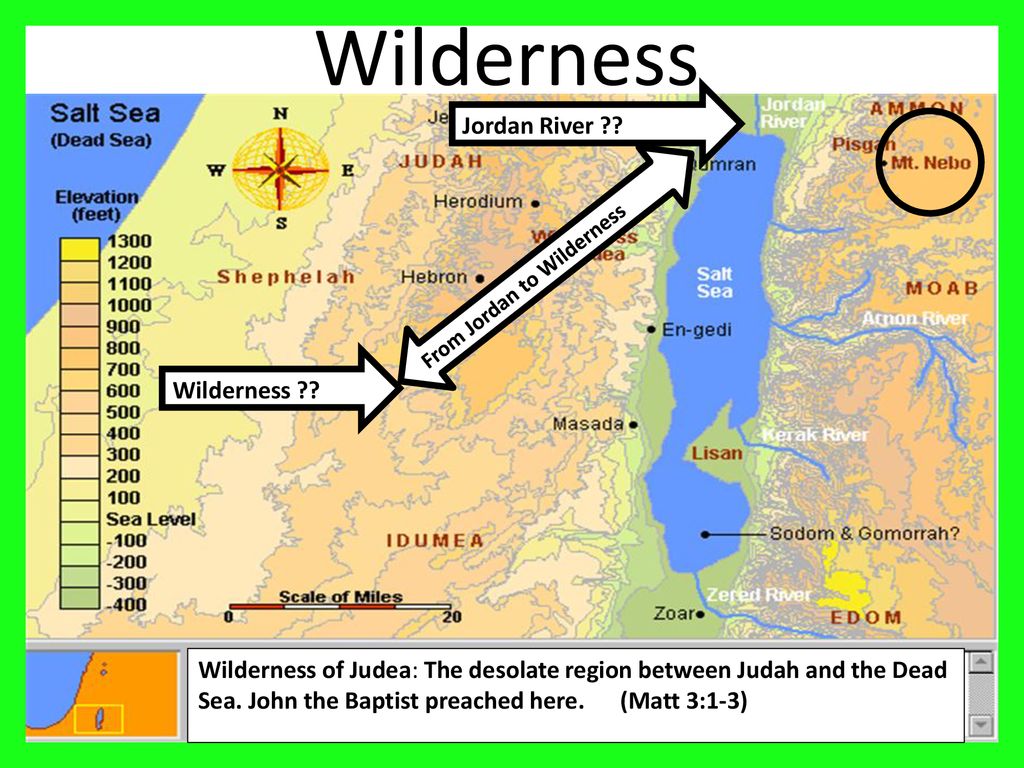
From Jordan to Wilderness. Wilderness Wilderness of Judea: The desolate region between Judah and the Dead Sea. John the Baptist preached here. (Matt 3:1-3)

END NOTES BSF STUDY QUESTIONS LESSON 3, DAY 2: MATTHEW 3:1-4

John the Baptist is son to Zacharias and Elizabeth, whom we met in Luke and how the couple had John by God’s miracle, too. John’s purpose is to prepare the hearts of God’s people for Jesus by telling them to turn to God.

Note the importance of the word “repent.”

John wanted everyone to know that the Messiah was coming so be ready!

Note that kingdom of heaven and kingdom of God is used interchangeably in the Bible. Both refer to God’s kingdome. Scholars believe that kingdom of heaven was used by Matthew since he was writing to Jews who did not like direct references to God. You’ll see kingdom of God used more in Mark and Luke.

It is super important to prepare for Jesus, which is why you all are here in Bible Study Fellowship’s study of Matthew! We must learn about Jesus, draw closer to him, and prepare for his Second Coming. Thus, John’s work is huge for believers.

A straight path to Jesus makes sense. Truthfully, is there any other way?

WHAT’S UP WITH THE CAMEL HAIR AND LEATHER BELT?

It doesn’t matter what John the Baptist wears; the point of this is that it was predicted that someone looking like John the Baptist would arise and point the way to the Messiah. Secondary is the fact that John the Baptist led a very simple life, and he made a powerful impact. We can do the same, too. We don’t need a lot to shine God’s light to the world. Contact me with questions!

BSF Study Questions Genesis Lesson 3, Day 2: Genesis 1:26-2:25 with Psalm 8 & Hebrews 2:6-9

Summary of passages:  Genesis 1:26-2:25:  Finishing up the sixth day, God made man in our image (our being God the father, Son, and the Holy Spirit) and let man rule over the fish, birds, livestock, and all of earth and its creatures.  He created both male and female.  God blessed man and told him to be fruitful and multiply.

God gave man every seed-bearing plant and every fruit for food.  He gave all the other living creatures green plants for food.  God saw all He made and it was good.

By the seventh day, God had finished his work so he rested and blessed the day as holy.

After God made the heavens and the earth but before plants had sprung and only streams had watered the earth, God made man from the dust of the ground and breathed life into his nostrils and man became living.  He put the man in the garden of Eden.  He made all kinds of trees for food and in the middle were the tree of life and the tree of knowledge of good and evil.  A river watered this garden.

God put man in charge of the garden to work it and take care of it.  He warned the man not to eat from the tree of knowledge or he would die.  He brought the animals to Adam to name.  When God did so, He noticed no helper was found for man; so He created woman from Adam’s rib while he was sleeping so man would not be alone.

This is why man will leave his father and mother and be united with his wife and become one flesh.  They were naked and felt no shame.

Psalm 8:  David sings God praises, saying how majestic He is. God set His glory above the heavens.  The praises of children silence God’s enemies. David asks the question many of us ask:  when we consider all you have made (the heavens, moon, and stars), why do you care for insignificant man so and crown him with glory and honor by making him ruler over everything?

How majestic is your name!

Hebrews 2:6-9:  Psalm 8 is quoted, “what is man that you are mindful of him…a little lower than the angels; you crowned him with glory and honor and put everything under his feet.”  Everything is subject to man, even things we do not see.  Jesus, who himself was made a little lower than angels, is crowned with glory and honor (the same as man’s) because he suffered death for everyone.

Questions:

3a)  Adam:  The Lord God formed the man from the dust of the ground and breathed into his nostrils the breath of life, and the man became a living being (2:7)

Eve:  The Lord God caused the man (Adam) to fall into a deep sleep; and while he was sleeping, he took one of the man’s ribs and closed up the place with flesh.  Then the Lord God made a woman from the rib he had taken out of the man, and he brought her to the man (2:21-22)

b)  Personal Question.  My answer:  We wouldn’t exist without Him.  And He made us companions for one another so we wouldn’t be alone.  I couldn’t make it in this Fallen world without help from God and humans.

4a)  God took Adam in the Garden of Eden to work it and take care of it.  (2:15)

b)  Personal Question.  My answer:  Yes.  We are the top of the food chain, the pyramid, the most intelligent beings, and we are formed in God’s image.  It is our responsibility to take care of our planet Earth and everything in it and to work it as God intended.

c)  In putting everything under him (man), God left nothing that is not subject to him.  Yet we do not see everything that is subject to him.  But we do see Jesus who has come to defeat death.

Main truth from these passages:  God originally gave man dominion over this earth (and the one to come) NOT angels even though man is a little lower than angels.  Man was created to rule earth.

This brings up the question:  how can Jesus rule and reign if he is not human?  Thus, Jesus became human so he (and we while Jesus is gone) can rule and reign over this world.

Thus, God gave man dominion over the earth; however, when man sinned and brought death (Romans 5:12), he gave up that power (but not the right) to rule.  The sin and death took away that power.  Thus, Jesus was sent to conquer death and restore God’s promise that humans will have dominion over the earth (Romans 5:21).  Because through Jesus man reclaims the dominion that God had originally intended for Adam (Revelation 5:10; Matthew 25:21).

Credit given to Enduring Word for explaining this to me!

5a)  To work and take care of Eden.  Basically, to care for God’s creations.

b)  Personal Question.  My answer:  To care for my family and husband; raise my kids in God’s ways.  For the world, I hope it’s through my novel.  But that’s just a hope.  At times, a very discouraging hope.  Something in my heart I can’t shake.  But one I believe is from God.

Conclusions:  Question 4c needed more background information.  I wouldn’t have been able to answer it without reading commentaries.  Piecing together the fact that one reason Jesus came as a man is to fulfill God’s promise of man having dominion over the earth is one I’ve never considered or heard of before.

In church, it’s all about how Jesus came to save us from our sins; to take them upon himself.  But this implication goes far beyond that.  Jesus came for us to rule.  Because God deigned us to (for some unknown reason).  Again, as in Psalm 8, I feel like David:  “what is man that you are mindful of him?”.

We are so little and insignificant.  But only in our eyes.  To God, we must be 10 feet tall!